Products
Forward deployed research for frontier science
Our scientists and engineers work with your team, using AI tools we built for physics and math research.
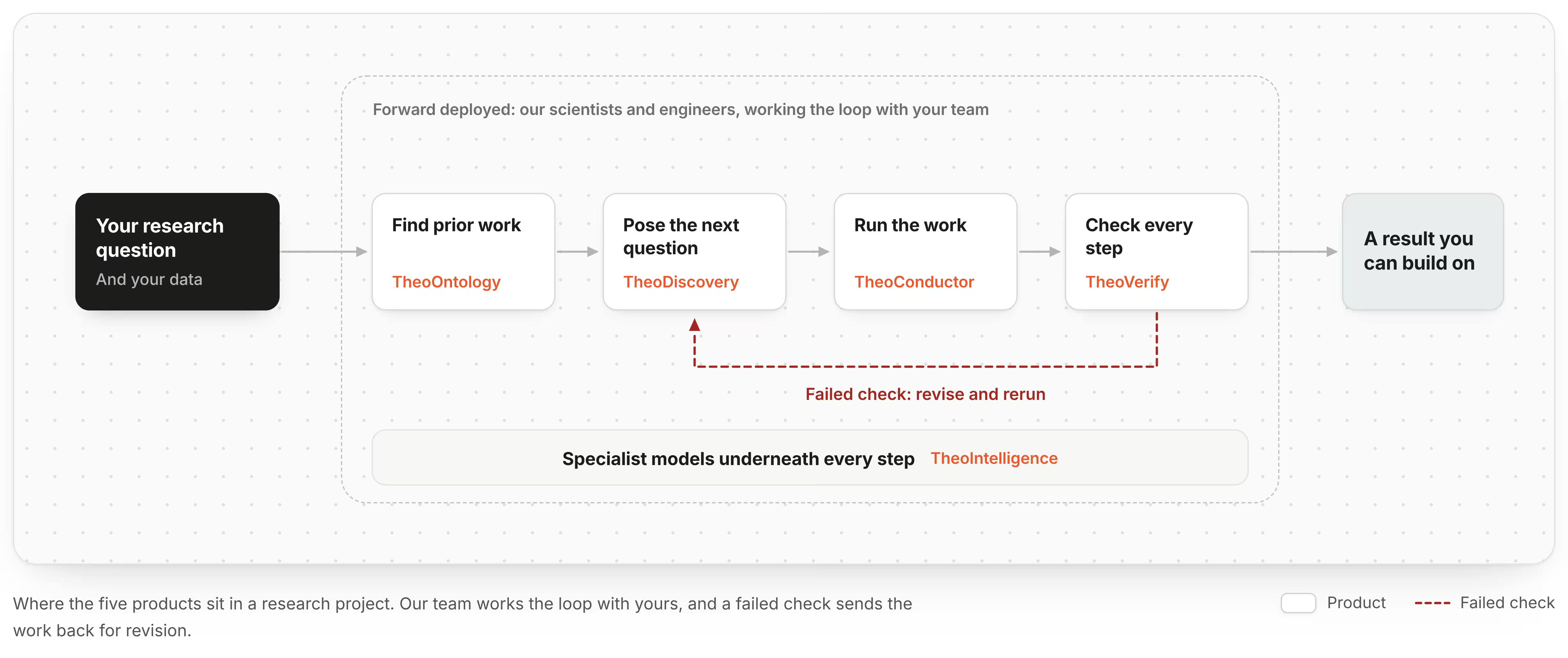
Five products, deployed where you work
Live
TheoVerify
Catch errors in AI-generated research before anyone builds on them.
TheoVerify runs several kinds of checks on each result:
- Extract each claim and each step.
- Run deterministic checks: dimensions, symbolic equivalence, limits and bounds.
- Test with numerical experiments.
- Have independent models and agents try to disprove it, including a cross-family judge that reviews methods as well as execution.
Every claim will be categorized as verified, partial, unsupported or refuted, with the evidence behind it. You can plug in your own checks too.
Today: math and citation checks available in Theo, and a cross-family judge can run in your workflow
With your team: checks built for your methods, run in your workflow. Spend less time reviewing.
Next: continuous review of every key result, and machine-checked proofs.
what we catch
Math and physics errors
A sign error or a units mismatch that changes the final answer.
Missing evidence
Claims with no supporting source, or a key source left out.
Citation errors
Made-up references, or papers cited for things they don’t say.
Unsupported claims
A statement presented as fact with no source or calculation behind it.
Tests that can’t fail
A check that passes no matter what the code does.
Reporting mistakes
A summary that says a check passed when it actually failed.
These are real errors we found, in Theo’s citation checks and in test runs where a model from another company reviewed research written by Claude.
Ways to use it
Proof points
EMNLP 2026
CiteCheck, our citation verifier, accepted at the GroundLM workshop.
19 blocking errors
That would have invalidated later work, among 214 findings in 10 recent runs.

Early access
TheoOntology
Everything your lab has done, searchable by words or equations, for you and your agents.
We built our own math embeddings, and they have the highest published precision on ARQMath-3, the standard benchmark for equation search. This extends to figures, plots and more.
For your research, we connect your papers, reports, notebooks and data into one map of everything you’ve done. You and your agents can search all of it.
This mapping is also what makes the AI models your team uses better at your work. Before a model answers, it gets the right pieces of your lab’s history, found through math and natural language. In our own research, an open model solved 25% more problems when our search gave it a relevant paper to read first. We call this scientific RAG.
Today: math-aware search across open scientific literature.
With your team: search and source-linked answers over your papers, reports, notebooks and raw data.
Scientific search for your lab

Ways to use it
Proof points
0.74
Precision at 10 on ARQMath-3 equation search across 9 million formulas, the highest published as of October 2026.
3M + 125M
Abstracts and equations indexed for search across arXiv.
Early access
TheoConductor
Get the best from every model, on every task, for less.
Conductor breaks a task into steps and sends each one to the model that gives the best value for that step, whether that’s a frontier model, one of ours or a smaller open model. It works for quick questions but shines on long research runs.
Today: multi-model runs inside Theo.
With your team: we tune Conductor on your own tasks, then show you what it costs and how its answers compare with the best single model you use today.
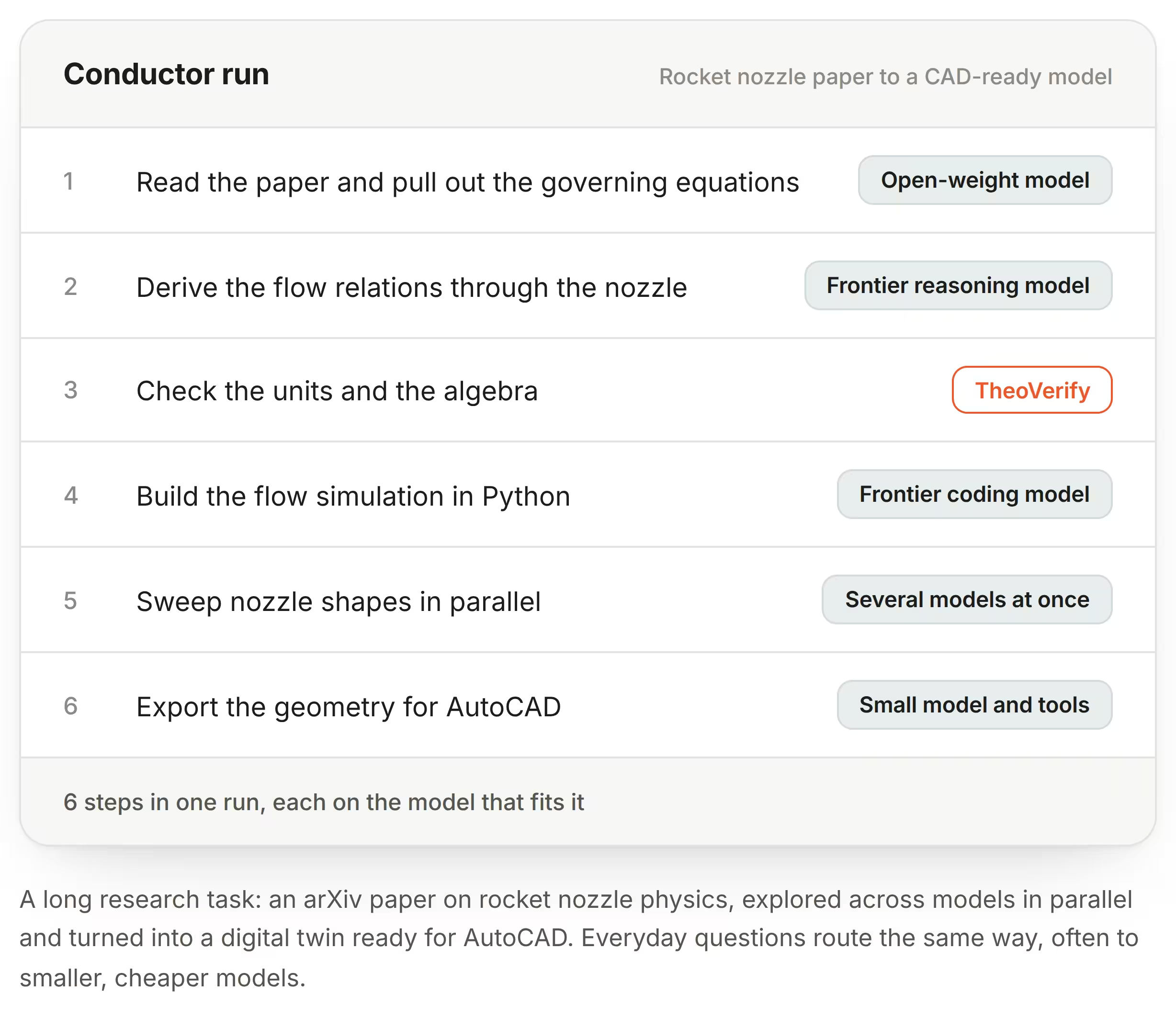
Ways to use it
Proof points
1 API
Works with OpenAI and OpenRouter, so your existing agents and scripts don’t need changes.
Major labs
Use models from Anthropic, OpenAI and Google alongside open models and our own, all in the same task.
Keeps running
If one provider goes down or hits a usage limit, Conductor moves the work to another.
Early access
TheoDiscovery
Find the next question worth asking.
TheoDiscovery runs on two engines. Serendipity reads the literature for methods from other fields that could move your problem forward. TheoX, a mathematical search engine that runs without an LLM, proposes novel conjectures from your data and tests them against counterexamples.
TheoDiscovery was used in a recent quantum physics paper with Gerard Milburn.
TheoDiscovery was used in a recent quantum physics paper with Gerard Milburn.
Today: Serendipity searches all of arXiv, and TheoX looks for new conjectures in your data.
With your team: We set up a custom implementation of Discovery on your data and problems, and you decide which ideas are truly novel and worth pursuing.
Serendipity: research directions from any paper
Give it a paper, and Serendipity returns ranked research directions grounded in a real paper from a field you may never have read by matching the structure of your equations, text and figures, then filters for ideas that hold up and are new. It comes up with cross-domain ideas more consistently than frontier models, whose suggestions tend to cluster around the same few.
87, 000
papers retrieved

12, 146
connections
2, 283
ideas that pass a novelty check
480
ranked research proposals
Connect people too
In development
In a large organization, not everyone can know everyone. Serendipity can match researchers whose work shares the same math, across teams and campuses, and suggest a problem they could take on together.
Saloons were where people met and traded ideas informally. When Prohibition closed them, US counties that lost them filed 8 to 18% fewer patents a year than counties that were already dry.
Who talks to whom shouldn’t depend on who sits near whom. Serendipity can match the researchers by the math they work on.
Who talks to whom shouldn’t depend on who sits near whom. Serendipity can match the researchers by the math they work on.
Open problems become benchmarks
In development
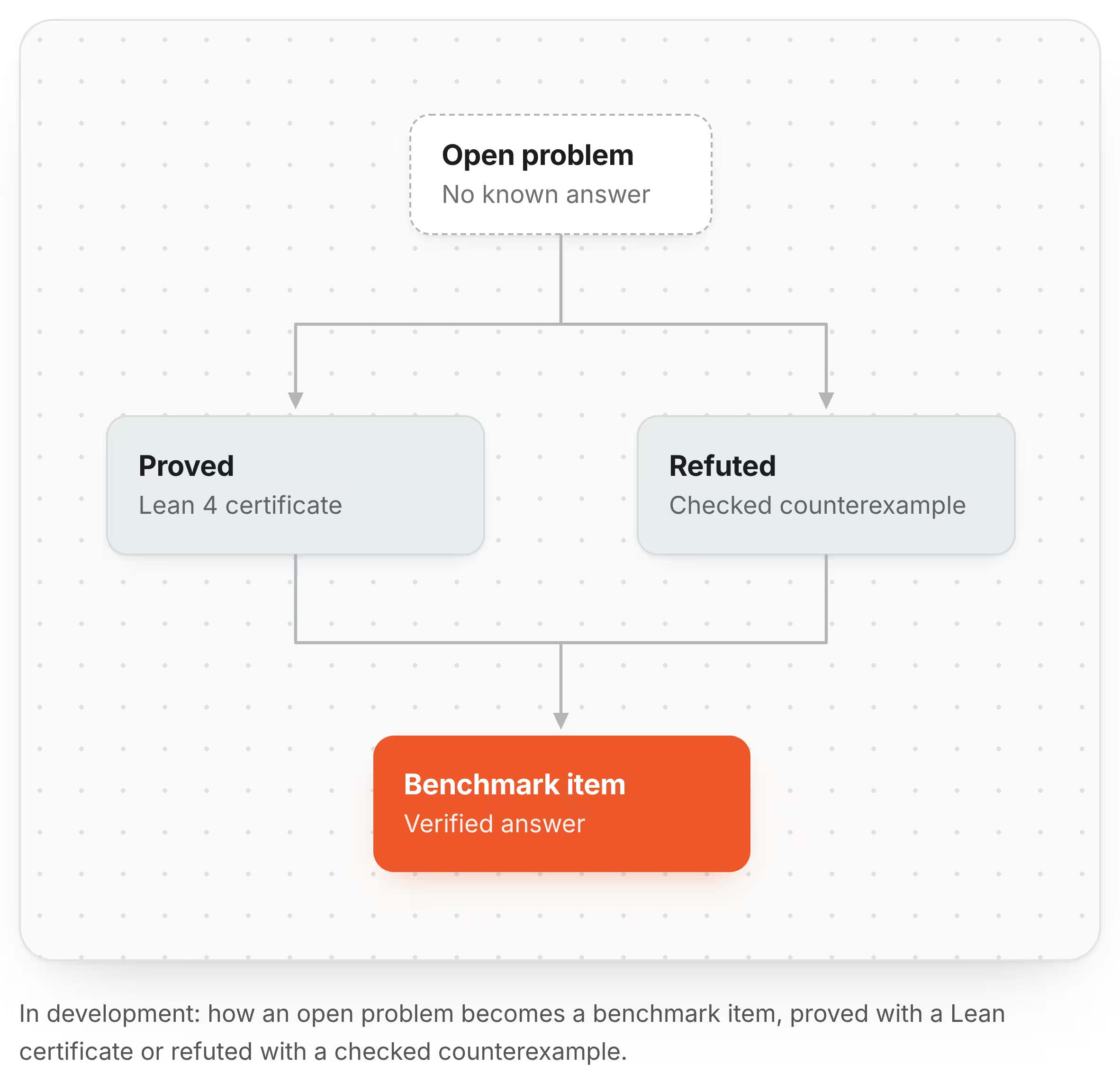
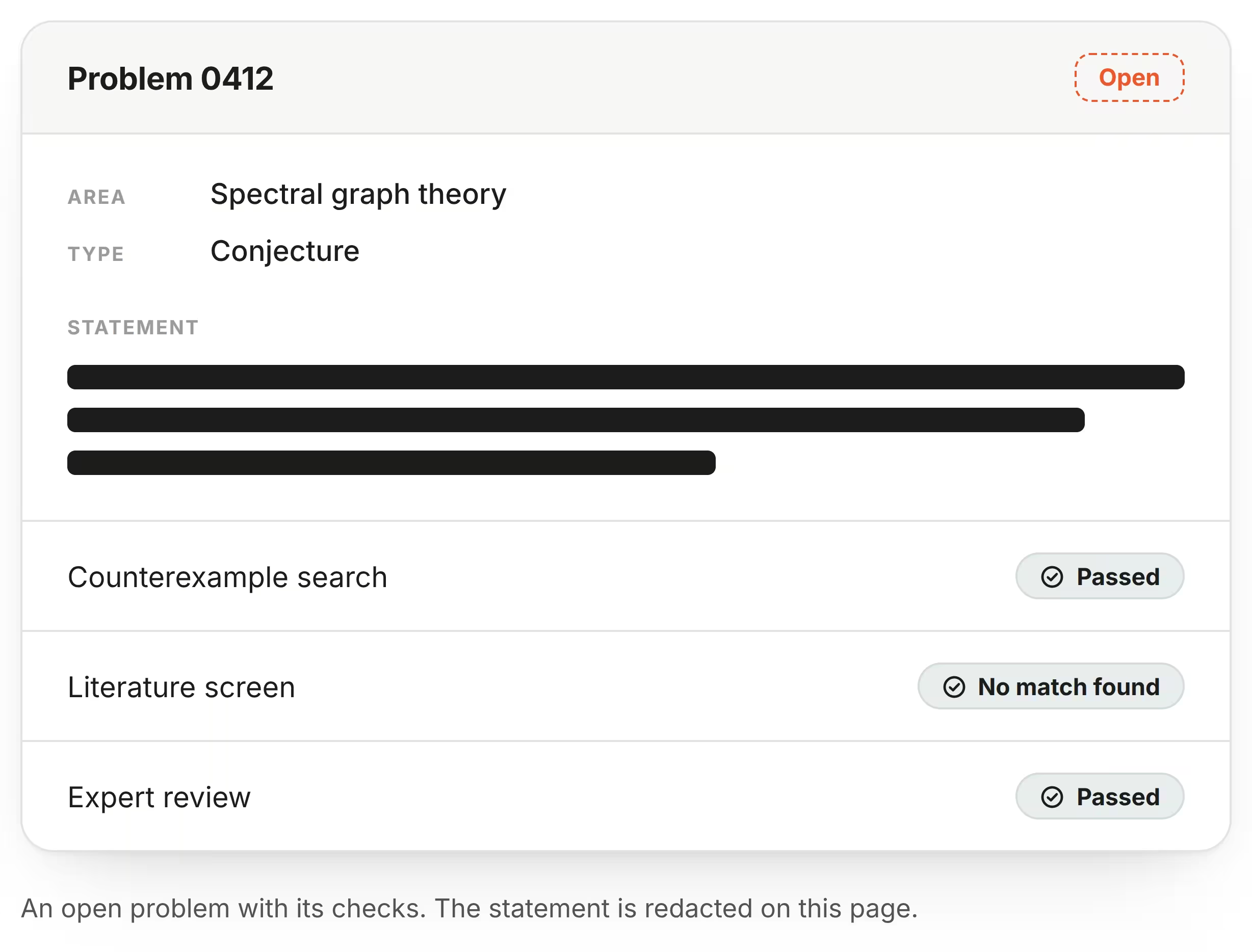
When someone solves one of the generated conjectures, we check the answer. Proofs go through Lean 4, and a program confirms counterexamples. An open problem can become a test question with a verified answer that you can run your models against. We keep these private so they stay out of training data.
who its for
Research teams
A discovery environment around your own data, definitions and examples. Each project can grow into reusable and personalized research software.
Courses
Every student creates a research program of their own and finishes the semester with software that captures all of their conjectures and solutions.
Model builders
Fresh open problems your models have never seen, with verified answers.
Ways to use it
Proof points
187 vs 47
Different research ideas in 200 Serendipity results. Asking a frontier model 200 times gave 47.
Lean 4
Every mathematical proof is checked.
Hundreds
Open problems in our collection that no frontier model has solved yet.
Design partners
TheoIntelligence
Specialist models, trained and evaluated on your task.
We take an open model and train it on examples of your work, using the science training data we’ve built up. The model is yours, and it can run on our servers or yours.
Ways to use it
Proof points
8B to 1T
Parameters we post-train, across the Qwen, Nemotron, DeepSeek, Kimi and GLM families.
SFT + RL
Fine-tuning and reinforcement learning, with our own verification
Yours
You own the model and the data behind it.

Deployed where you work
All of our products run on Theo, our research environment for physics and math. You can use them on our servers, in your own cloud account or on your own hardware.We don’t train shared models on your data. Anything built from it, like a custom model, stays with you. What we keep are the general methods and tools we bring to every project.
Managed by us
The fastest start: Theo and our API, run by our team.
In your cloud
Your own cloud account, your keys and your choice of models.
On your hardware
On-premises and air-gapped deployments for enterprise engagements.
Ways to work together
1
Use Theo
Researchers start free with 1,500 credits.
2
Plug in
Connect your models, codes and data sources to Theo.
3
License
Run a custom version of Theo on your own stack.
4
Custom build
Our forward deployed team builds it into your workflow.
5
Discovery Partnership
You fund a research problem and our scientists work on it with yours.
Consultancies and integrators: bring our products into your client engagements.
Research partnerships
Paid research pilots
Pick one research question and we’ll work on it with you.
Sponsored research programs
Bigger projects that run over months.
Program partnerships
Theo access, training and support for doctoral networks, institutes and research consortia.
Recent results with Theo





Theo's Science-native AI
Backed by domain-specialized AI for science
Observe & Research
arXiv
Web Search
Knowledge Graph
Books
Lectures, Interviews
Deeper next questions
Question Formulator
Findings
Feedback
Evaluator
Anomaly detection, gap analysis, novelty assessment
Known- & Unknown-Unknowns
Postdictions & New Unknowns
Hypothesize & Solve
General Physics
Quantum Physics
Large Hosted MoE Model
Additional Specialized Models
Symbolic Regression
Math & Symbolic Engine
Conjecturing-Based Theorization
Additional Specialized Tools
Predictions
Test & Analyze
Quality-Check & Compare to Observed Discrepancies
Simulations & Modeling
Experimentation & Labs-in-the-loop
Live External Observation Data
Evaluated Results
Output & Feedback
Theo Notebook UI
Theo Logging & Tracing
Paper Writing Capability
Feedback from Theo Collaborators Program
Feedback from RLHF
Tell us what you are working on
We start by learning your problem, then suggest the product, bootcamp or scope that fits it.
Thank you! Our team has received your request and will reach out within 24 hours.
Oops! Something went wrong while submitting the form.