
FirstPrinciples
.avif)
Over the past year, our team has spent a great deal of time with researchers in physics and mathematics, watching how they work and asking where the process tends to break down. Their answers were consistent in that the work surrounding the science struggled to adapt to AI-enabled systems.
Researchers were finding themselves having to start from scratch when a conversation thread began to lose the plot. They were working across multiple tools and platforms, making switching between them a clunky part of their workflow. When a hypothesis shifted midway through a project, or when a result needed to be tested under different conditions, there was no easy way to revisit prior steps without losing everything downstream. When a source was cited, or related literature was presented, it was leaving researchers unsure of whether the result could be trusted.
Theo is our response to those conversations and our own experience.
Theo is a scientific workflow platform designed to help researchers carry a question from hypothesis through to a verifiable result, all under one roof. Theo has a solid framework for working through complex scientific problems, and we’re just getting started.
Guided by domain-specialized AI
Theo's model pool contains models specifically fine-tuned to reason through scientific problems. Theo includes GLM 5.2 and Kimi K2, open-weight models post-trained by FirstPrinciples for physics and mathematics. These models are being developed specifically for scientific reasoning to work through technical assumptions, mathematical arguments, physical systems, and multi-step research questions.
Compare models in one workspace
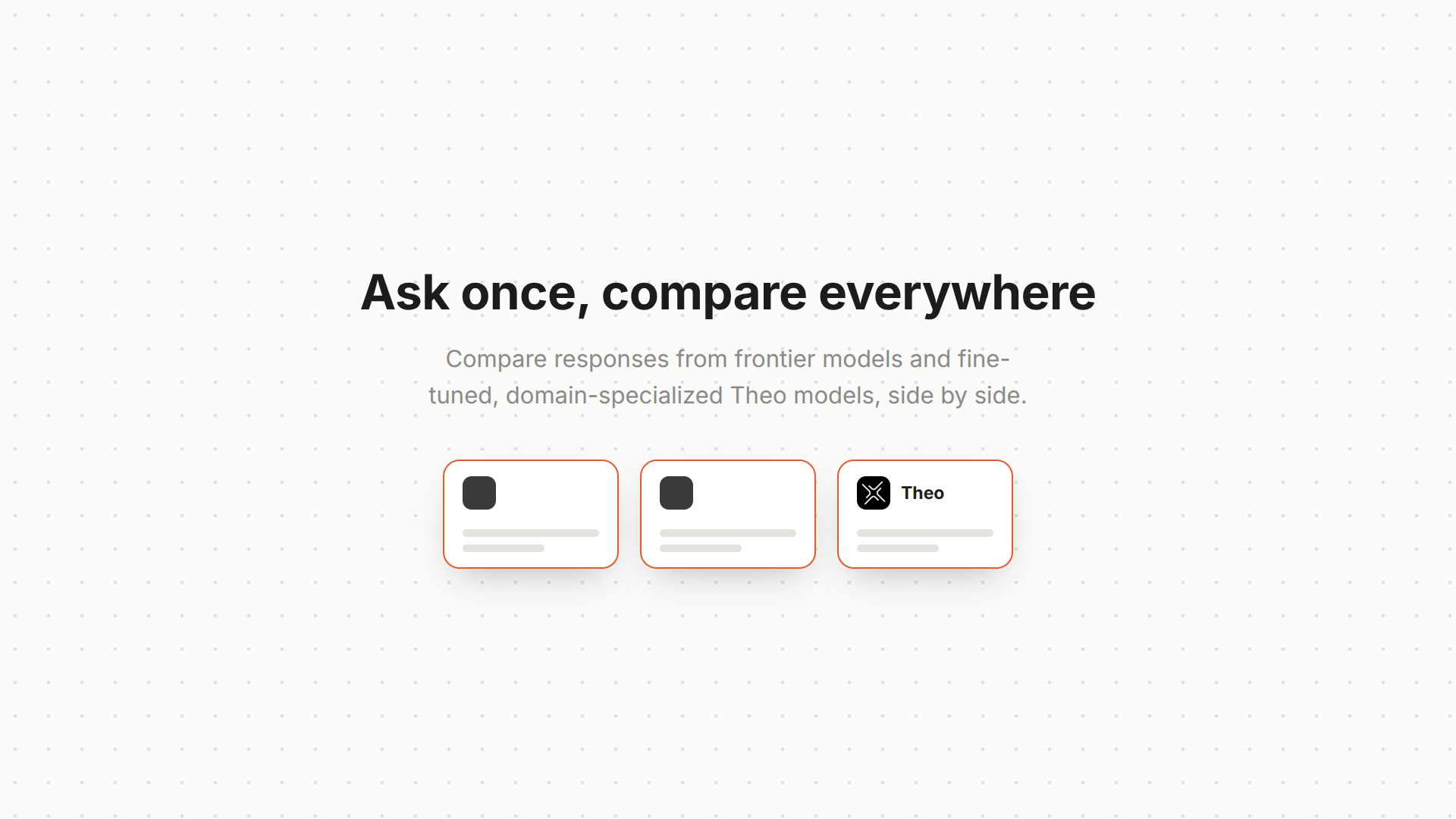
Theo routes each task to the model best suited for it, drawing on both its own domain-specialized physics models and leading frontier models. Researchers can override that choice at any point. For results that need verification, Council Mode runs several models on the same problem side by side. It shows where their derivations agree, flags where they diverge, and surfaces likely hallucinations or errors before they make it into your work.
Verifiable results
Theo doesn’t let a model grade its own work. The platform uses separate verification services to assess different parts of the research process instead of asking the model that produced a result to simply approve its own work.
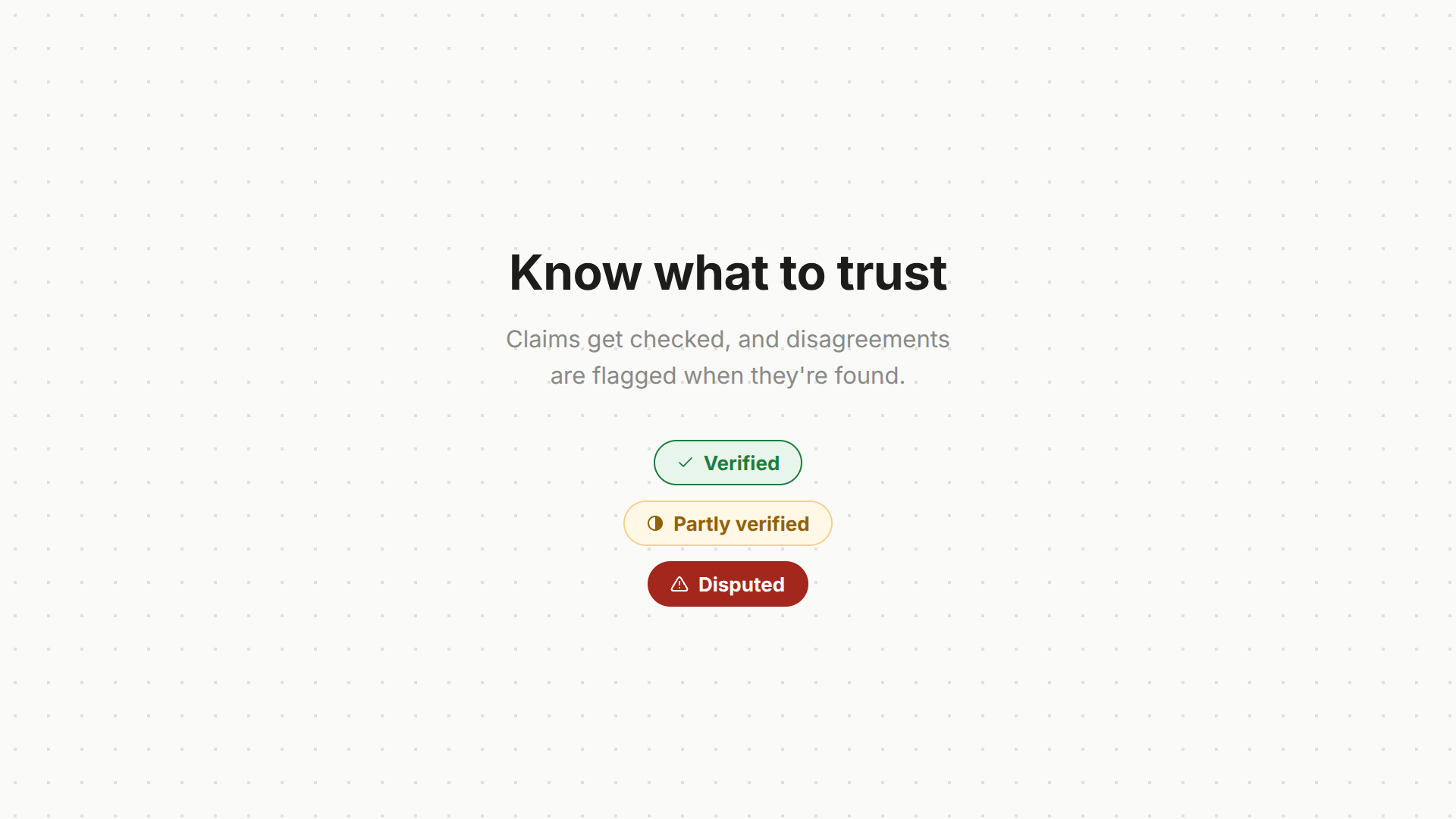
Citation Verification checks whether a cited work exists, whether its bibliographic information is accurate, and whether the available evidence supports, contradicts, or is insufficient for the claim attached to it.
For supported structured mathematical derivations, the FirstPrinciples Step-Level Verification Pipeline records the assumptions, symbols, intermediate steps, and dependencies in the reasoning. It then applies deterministic checks such as dimensional analysis, symbolic substitution, algebraic comparison, coefficient matching, and bounded numerical testing.
The system reports what it could establish and what it could not. A derivation may be marked Verified, Issues Found, Partially Verified, or Verification Incomplete, with step-level explanations that show where the result follows and where the verifier could not safely decide.
Cross-model Council review, citation checking and deterministic derivation checks provide different kinds of evidence. None eliminates the need for scientific judgment, but together they make it easier to inspect how a result was produced.
Connect to scientific tools
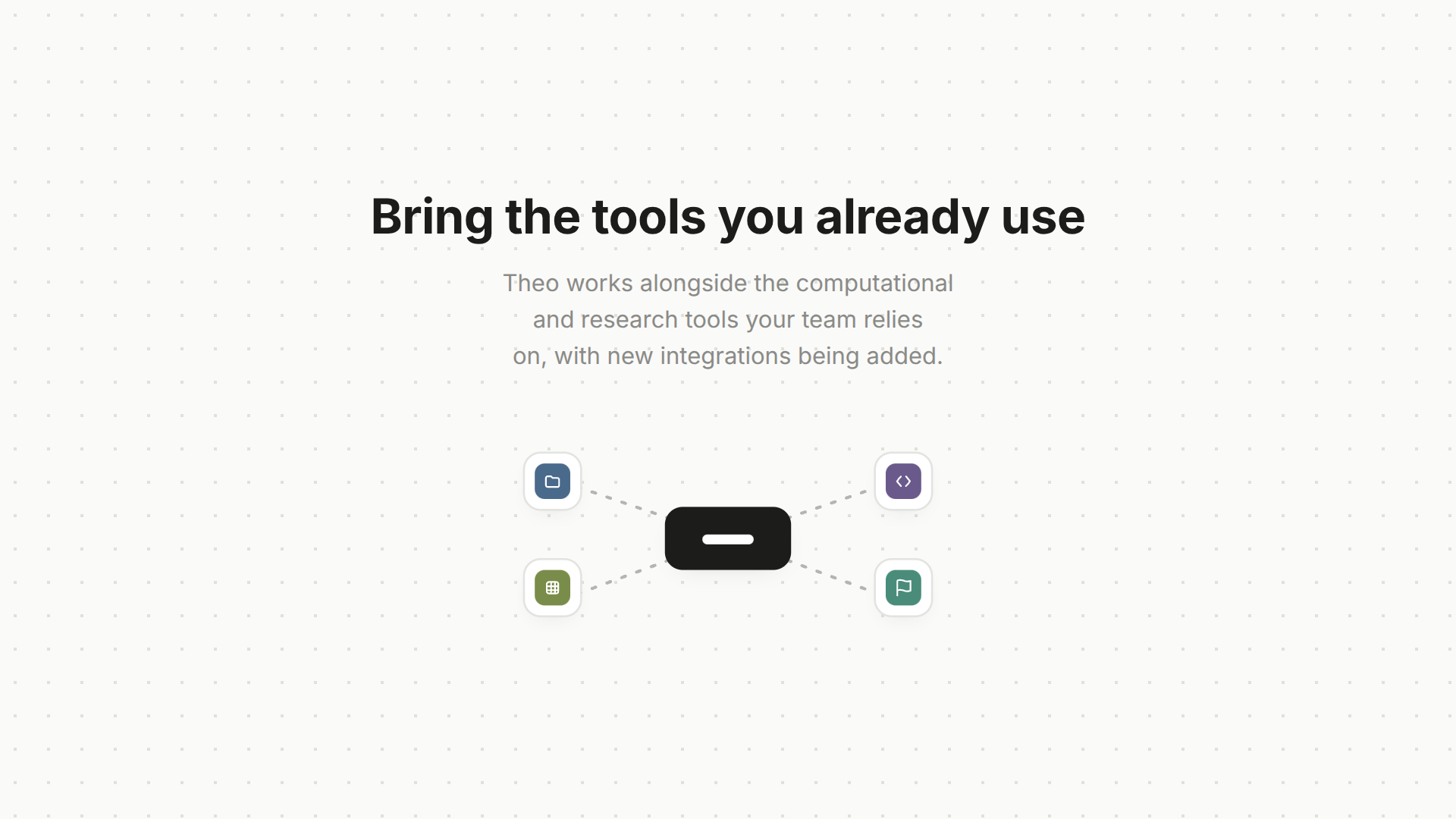
We're building Theo to work with the computational and symbolic tools your team already relies on (Python, Mathematica, and SageMath) with new integrations added regularly. If there’s something you’d like to see integrated next, let us know.
Workflows that work the way you do.
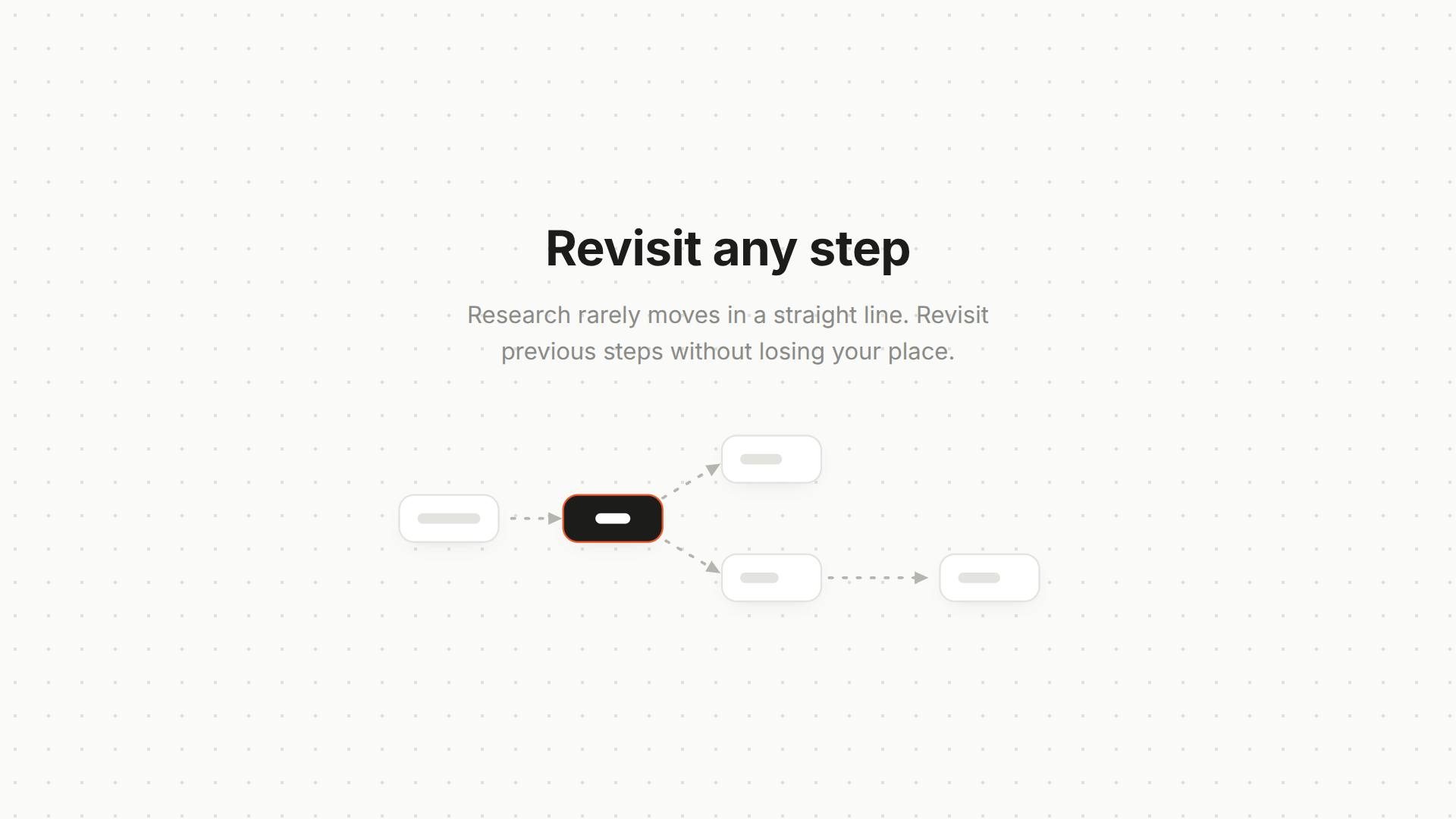
Build a research plan with guided validation, adjust variables or methods at any step, and re-run only what changed, without restarting everything. Every session builds a research graph, not a linear session, so revisiting an earlier decision doesn't mean losing the rest of your work.
Every AI research tool claims to be more than a thin layer over someone else's model. So, here's what we can point to.
CiteCheck, the system behind Theo's citation checking, is a published preprint, not a marketing claim. CiteCheck is “a hybrid framework for citation hallucination detection that verifies whether a citation corresponds to a real scholarly work and whether its metadata is faithful to that work”. In a 982-citation physics benchmark built specifically for this problem, it scored 88.7 macro-F1 and 88.9% accuracy, outperforming GPT, Claude, and Gemini baselines, including versions of those models given web search and few-shot examples.
A companion system, DeepSciVerify, improves further on claim-citation alignment by addressing claim legitimacy and cited evidence, escalating from abstract-level to full-text evidence only when needed. Both are public, published preprints, so you don’t have to take internal numbers on faith.
Aside from our citation verification systems, Theo has also contributed to scientific results.
Our automated conjecturing system, Theo Discovery, generated five conjectures in graph domination theory, of which, one of them proved true. Researchers disproved another with a counterexample, and the remaining three have partial supporting evidence and are still open. This paints an honest picture of what an automated discovery system actually does. It isn’t a highlight reel or a claimed discovery, but rather a problem being worked on with researchers steering the system.
Theo's research system has also helped settle a problem with history behind it. In the 1980s, Paul Erdős and William Staton found a lower bound on a graph-theoretic quantity called the Havel–Hakimi residue for common-divisor graphs, and Staton went a step further, predicting that the constant in their bound was exact. However, no published proof of that prediction has been found. Working with Theo’s discovery system, FirstPrinciples’ Member of Technical Staff, Randy Davila, confirmed Staton's predicted constant, derived the complete asymptotic expansion, and in the process found new criteria (built from the same graph statistics) that are mathematically equivalent to the Riemann hypothesis. These restate the hypothesis in graph-theoretic terms, though they do not bear on whether it is true.
Separately, Randy Davila and Gerard Milburn, Quantum Fellow at the National Quantum Computing Centre, used the Theo platform as part of a paper on decoherence models, with a transparent disclosure of exactly where the AI assisted and what the human authors checked and verified.
Theo is also showing up in published research. A team of physicists working with our staff physicist, Xingyang Yu, acknowledged Theo for help preparing the manuscript of a recent M-theory paper. Writing up results is a critical part of research. Theo is earning its place in that workflow.
Preparing a manuscript rarely draws attention, yet the care taken at this stage shapes how clearly the work reaches its readers. Seeing Theo used in that part of a collaboration shows it fitting into the everyday work that research depends on.
Lean-based formal proof is in development; our tool integrations are growing; and our research team continues to improve our domain-specialized models.
The researchers who used early versions of Theo shaped version 1.0, and researchers using it now will shape what comes next. With ongoing support, testing, and user feedback, it will get us to our next version, and much improved versions for future research.
If you're a researcher, get started with Theo for free. Our team will set up your workspace and send you a login link. If you're bringing Theo to a lab, department, or company, request a demo and we'll build a session around a problem your team is actively trying to tackle.