
FirstPrinciples
In the summer of 1956, at a legendary workshop at Dartmouth College, four researchers proposed that "every aspect of learning or any other feature of intelligence can in principle be so precisely described that a machine can be made to simulate it." Early systems like DENDRAL and MYCIN encoded human knowledge as elaborate trees of if-then statements — powerful, yet narrow. They couldn't adapt; they could only look up.
By the late 1970s, funding dried up, triggering an "AI winter." The problem wasn't just technical but conceptual: symbolic systems assumed the world could be exhaustively described in logic. What machines needed was not more syllogisms but pattern recognition.
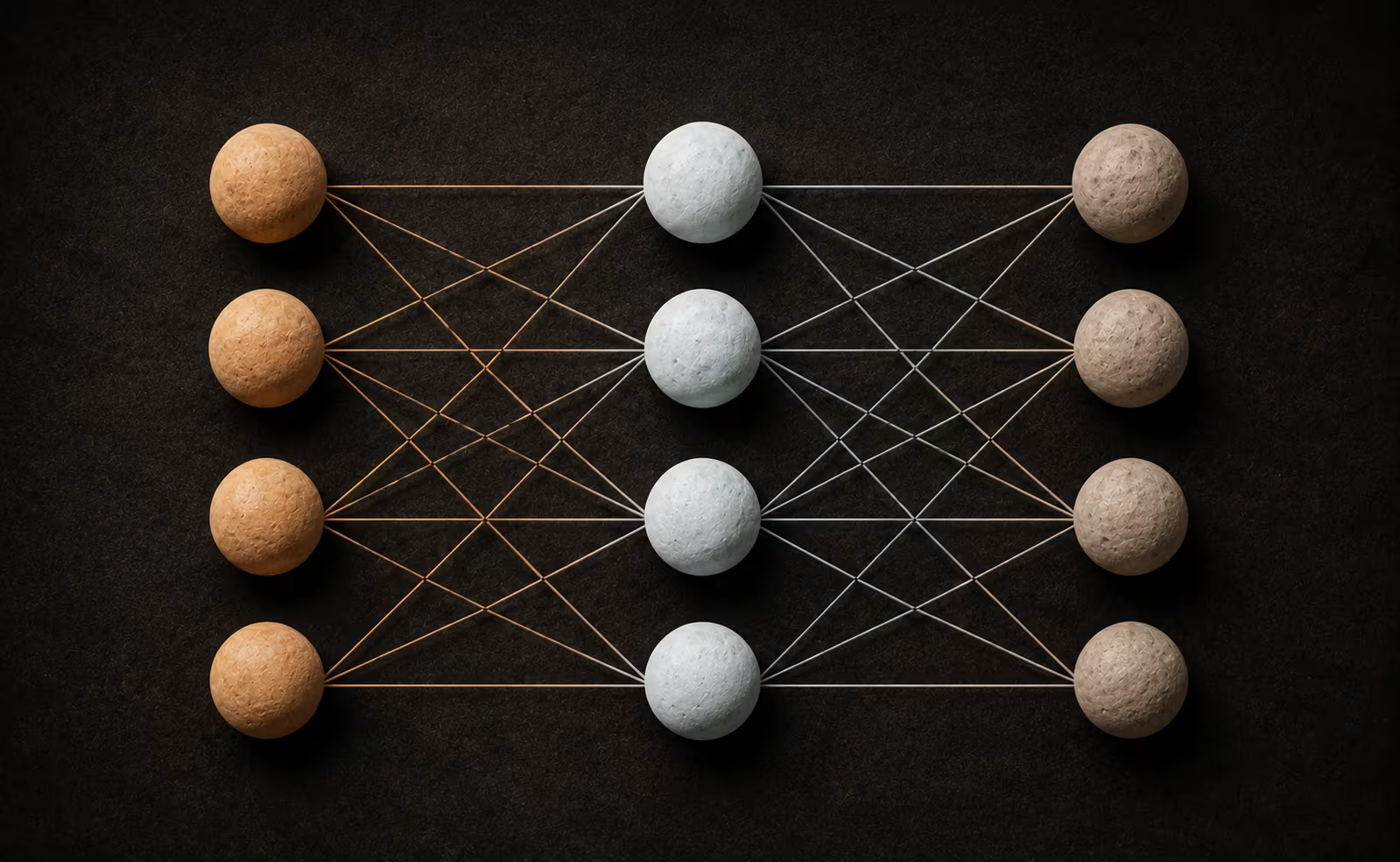
By the late 1990s, machine learning began to eclipse symbolic AI. Deep learning breakthroughs — including Geoffrey Hinton's work on backpropagation and deep belief networks, which earned a share of the 2024 Nobel Prize in Physics — paved the way for modern neural networks. But these techniques introduced a new trade-off: opacity. These models could predict, yet rarely explain. They mapped correlations, not causes.
In 2020, DeepMind's AlphaFold made accurate predictions of protein three-dimensional folds with precision unmatched by any previous system. But AlphaFold does not explain why proteins fold as they do; it cannot account for the mechanism — the deep structure of physical explanation that science demands.
LLMs can summarize scientific papers, draft grant proposals, generate code, and answer technical questions. But scientific reasoning demands rigor: formal, structured, internally coherent. LLMs are trained to predict the next most likely word in a sentence — their knowledge is statistical, not structural; they simulate, and often hallucinate. Science operates on symmetries, conservation laws, and mathematical logic, not on token frequency or textual proximity.
The next breakthrough in AI won't come from bigger models or faster GPUs. It will come from systems that reason, not just simulate; that seek principles, not just patterns. That's how we keep the soul of science intact in an automated age.
This article was created with the assistance of artificial intelligence and thoroughly edited by FirstPrinciples staff and scientific advisors.